
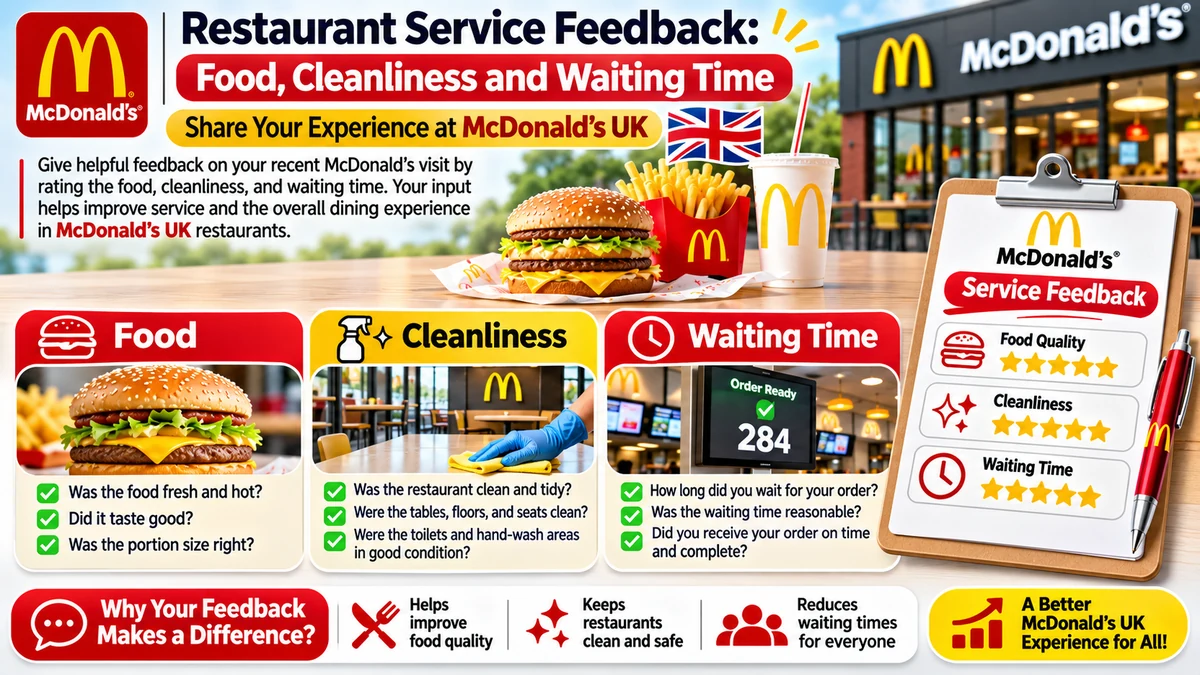
A thoughtful restaurant review evaluates the specific elements you experienced rather than assigning blame from a single impression. This guide provides a structured way to describe food, staff, waiting time, facilities and order accuracy so your feedback remains fair, precise and genuinely useful.
Quick overview
A detailed visit checklist for fair ratings of food, customer service, cleanliness, waiting times and accessibility. If you are trying to use an actual participation code, the appropriate destination is the official survey. If you need to redeem an issued voucher, refer to the conditions in the email and the current terms. If your goal is simply to record a genuine restaurant experience, our feedback writing tool is a separate browser-based aid.
- Set an appropriate context
- Describe food quality as observed
- Review order accuracy
- Assess waiting times carefully
- Notice staff communication
- Observe tables and shared areas
- Include accessibility details
- Consider family facilities
- Distinguish peak and quiet periods
- Recognise effective problem solving
- Write improvement suggestions
- Use the right reporting channel
- Examples and decisions
- Frequently asked questions
1. Set an appropriate context
State whether you used dine-in, takeaway, drive-through or delivery, and approximately when. Different channels can shape the experience. This is most useful when you identify the exact stage of your experience before trying to solve it. The wording on a particular receipt, voucher or service screen is more informative than a generic example from the internet.
The useful starting point. Rather than assume every receipt and restaurant behaves the same way, use the details on the actual document or visit. A brief check of the official source is worthwhile whenever the question involves entitlement, expiry or accepted entry methods. The strongest result is not the longest answer: it is a clear action based on evidence you can verify. A useful cross-check for this topic is also assess waiting times carefully: Use an estimated duration and indicate how busy the restaurant seemed. A single slow order does not prove a permanent problem.
2. Describe food quality as observed
Comment on temperature, texture, taste and presentation, avoiding speculation about food handling you could not see. This is most useful when you identify the exact stage of your experience before trying to solve it. The wording on a particular receipt, voucher or service screen is more informative than a generic example from the internet.
A small but important distinction. General guidance and a decision about an individual customer are separate. Information on this site describes sensible next steps, while official systems decide whether an invitation or voucher is accepted. This distinction also protects readers from websites that falsely promise to unlock a reward or guarantee redemption. A useful cross-check for this topic is also notice staff communication: Describe whether requests were acknowledged, updates were offered and the team explained delays clearly.
3. Review order accuracy
Compare what you requested with what arrived. Explain whether an error was corrected promptly and without argument. This is most useful when you identify the exact stage of your experience before trying to solve it. The wording on a particular receipt, voucher or service screen is more informative than a generic example from the internet.
Keep the record straightforward. A short factual note can be more valuable than a long emotional description. When you can, include what happened, which part of the process it affected, and what you tried. Leave out private strings, contact data and assumptions about staff intentions. This gives an official support adviser enough context to direct the issue without exposing unnecessary details. A useful cross-check for this topic is also observe tables and shared areas: When discussing cleanliness, describe visible tables, bins, floors or toilets without making unsupported claims about hidden areas.
4. Assess waiting times carefully
Use an estimated duration and indicate how busy the restaurant seemed. A single slow order does not prove a permanent problem. This is most useful when you identify the exact stage of your experience before trying to solve it. The wording on a particular receipt, voucher or service screen is more informative than a generic example from the internet.
One action at a time. If a step does not work, do not change several variables simultaneously. Check the address and the specific instruction, then make a single appropriate correction. If there is still an issue, record the visible error wording and ask for official help. Random repeated attempts or code-sharing sites rarely provide a dependable answer. A useful cross-check for this topic is also include accessibility details: Mention entry routes, queues, kiosk usability, seating layout and signage only if these were relevant to your visit.
5. Notice staff communication
Describe whether requests were acknowledged, updates were offered and the team explained delays clearly. This is most useful when you identify the exact stage of your experience before trying to solve it. The wording on a particular receipt, voucher or service screen is more informative than a generic example from the internet.
Why readers revisit this information. A later visit may involve a different restaurant, different printed layout or changed promotion. Save the official terms page and return when you have a new receipt or voucher; do not rely on a remembered detail from an older transaction. This helps distinguish genuinely new conditions from familiar but outdated information. A useful cross-check for this topic is also consider family facilities: If applicable, discuss high chairs, space for prams and general organisation without revealing children’s identities or private information.
6. Observe tables and shared areas
When discussing cleanliness, describe visible tables, bins, floors or toilets without making unsupported claims about hidden areas. This is most useful when you identify the exact stage of your experience before trying to solve it. The wording on a particular receipt, voucher or service screen is more informative than a generic example from the internet.
Respect the limits. No independent website can establish authenticity merely from an attractive picture or a code’s appearance. A result from our formatter or draft writer remains educational. A final eligibility decision, redemption and customer-service response must come from the official McDonald’s channel named in the relevant terms. A useful cross-check for this topic is also distinguish peak and quiet periods: Friday evening and mid-morning service can differ. A useful comparison recognises time-of-day context rather than assuming identical staffing.
7. Include accessibility details
Mention entry routes, queues, kiosk usability, seating layout and signage only if these were relevant to your visit. This is most useful when you identify the exact stage of your experience before trying to solve it. The wording on a particular receipt, voucher or service screen is more informative than a generic example from the internet.
The useful starting point. Rather than assume every receipt and restaurant behaves the same way, use the details on the actual document or visit. A brief check of the official source is worthwhile whenever the question involves entitlement, expiry or accepted entry methods. The strongest result is not the longest answer: it is a clear action based on evidence you can verify. A useful cross-check for this topic is also recognise effective problem solving: A team that acknowledges a mistake and resolves it deserves mention. The way an issue was handled is part of the service.
8. Consider family facilities
If applicable, discuss high chairs, space for prams and general organisation without revealing children’s identities or private information. This is most useful when you identify the exact stage of your experience before trying to solve it. The wording on a particular receipt, voucher or service screen is more informative than a generic example from the internet.
A small but important distinction. General guidance and a decision about an individual customer are separate. Information on this site describes sensible next steps, while official systems decide whether an invitation or voucher is accepted. This distinction also protects readers from websites that falsely promise to unlock a reward or guarantee redemption. A useful cross-check for this topic is also write improvement suggestions: Ask for a practical change—clearer queue guidance or better order checks—rather than using insults or unrealistic demands.
9. Distinguish peak and quiet periods
Friday evening and mid-morning service can differ. A useful comparison recognises time-of-day context rather than assuming identical staffing. This is most useful when you identify the exact stage of your experience before trying to solve it. The wording on a particular receipt, voucher or service screen is more informative than a generic example from the internet.
Keep the record straightforward. A short factual note can be more valuable than a long emotional description. When you can, include what happened, which part of the process it affected, and what you tried. Leave out private strings, contact data and assumptions about staff intentions. This gives an official support adviser enough context to direct the issue without exposing unnecessary details. A useful cross-check for this topic is also use the right reporting channel: For a refund, safety concern or personal complaint requiring a reply, the official customer service route is more appropriate than a generic public review.
10. Recognise effective problem solving
A team that acknowledges a mistake and resolves it deserves mention. The way an issue was handled is part of the service. This is most useful when you identify the exact stage of your experience before trying to solve it. The wording on a particular receipt, voucher or service screen is more informative than a generic example from the internet.
One action at a time. If a step does not work, do not change several variables simultaneously. Check the address and the specific instruction, then make a single appropriate correction. If there is still an issue, record the visible error wording and ask for official help. Random repeated attempts or code-sharing sites rarely provide a dependable answer. A useful cross-check for this topic is also set an appropriate context: State whether you used dine-in, takeaway, drive-through or delivery, and approximately when. Different channels can shape the experience.
11. Write improvement suggestions
Ask for a practical change—clearer queue guidance or better order checks—rather than using insults or unrealistic demands. This is most useful when you identify the exact stage of your experience before trying to solve it. The wording on a particular receipt, voucher or service screen is more informative than a generic example from the internet.
Why readers revisit this information. A later visit may involve a different restaurant, different printed layout or changed promotion. Save the official terms page and return when you have a new receipt or voucher; do not rely on a remembered detail from an older transaction. This helps distinguish genuinely new conditions from familiar but outdated information. A useful cross-check for this topic is also describe food quality as observed: Comment on temperature, texture, taste and presentation, avoiding speculation about food handling you could not see.
12. Use the right reporting channel
For a refund, safety concern or personal complaint requiring a reply, the official customer service route is more appropriate than a generic public review. This is most useful when you identify the exact stage of your experience before trying to solve it. The wording on a particular receipt, voucher or service screen is more informative than a generic example from the internet.
Respect the limits. No independent website can establish authenticity merely from an attractive picture or a code’s appearance. A result from our formatter or draft writer remains educational. A final eligibility decision, redemption and customer-service response must come from the official McDonald’s channel named in the relevant terms. A useful cross-check for this topic is also review order accuracy: Compare what you requested with what arrived. Explain whether an error was corrected promptly and without argument.
Six practical situations to think through
The following situations are illustrative, not claims that particular customers completed these actions. They show how to translate the rules and observations into a sensible next step.
Scenario 1: Set an appropriate context
Suppose the first attempt to use an official form produces a vague error. The key issue is set an appropriate context. State whether you used dine-in, takeaway, drive-through or delivery, and approximately when. Different channels can shape the experience. In this situation, first identify what the person actually knows and what is still uncertain. Resist the temptation to turn an example into an eligibility promise, especially if a code or offer is involved.
Suggested response: A survey invitation, receipt or voucher can include information that should not be published online. When asking for help, describe the error and identify the type of code rather than posting the entire string. Avoid including full card numbers, personal contact details, staff identities or unrelated information. If the official service needs transaction information for support, provide it only through its trusted channel. These precautions are useful even when the website you are using appears legitimate. The safest next step is to check the current official terms or contact official customer services when the situation concerns a specific visit.
Scenario 2: Describe food quality as observed
Picture a reader who wants to protect their privacy while asking for help. The key issue is describe food quality as observed. Comment on temperature, texture, taste and presentation, avoiding speculation about food handling you could not see. In this situation, first identify what the person actually knows and what is still uncertain. Resist the temptation to turn an example into an eligibility promise, especially if a code or offer is involved.
Suggested response: Terms often separate eligibility, redemption, timing and exclusions into different paragraphs. A headline about a free item rarely tells you the qualifying spend, whether the restaurant participates or when the voucher expires. Read the condition attached to your exact offer and completion date. The wording for a survey carried out in an earlier promotion period may not describe a new survey. When this guide summarises terms, the original official source remains authoritative. The safest next step is to check the current official terms or contact official customer services when the situation concerns a specific visit.
Scenario 3: Review order accuracy
Imagine comparing an earlier survey result with a new promotion period. The key issue is review order accuracy. Compare what you requested with what arrived. Explain whether an error was corrected promptly and without argument. In this situation, first identify what the person actually knows and what is still uncertain. Resist the temptation to turn an example into an eligibility promise, especially if a code or offer is involved.
Suggested response: The tools on this website are designed to support understanding and help compose your own notes. They do not connect to McDonald’s survey database, issue free food, prove a purchase took place or send feedback to the company. A local result should therefore be read as information or a draft, not an approval message. If you need the official process, use the official survey address and follow that service’s instructions. If you want to keep a draft for later, make sure you understand whether it stays in your browser. The safest next step is to check the current official terms or contact official customer services when the situation concerns a specific visit.
Scenario 4: Assess waiting times carefully
Consider a customer trying to avoid unnecessary delays during a short visit. The key issue is assess waiting times carefully. Use an estimated duration and indicate how busy the restaurant seemed. A single slow order does not prove a permanent problem. In this situation, first identify what the person actually knows and what is still uncertain. Resist the temptation to turn an example into an eligibility promise, especially if a code or offer is involved.
Suggested response: A plausible-looking code, realistic photograph, polished logo or confident piece of advice is not evidence of company authorisation. A receipt might display numbers that are not a survey participation invitation. A voucher might be authentic but already redeemed or outside its expiry period. An appealing online offer might refer to an earlier campaign. Compare the claim with the official text and the actual document you hold before drawing a conclusion. When in doubt, stop rather than trying random codes. The safest next step is to check the current official terms or contact official customer services when the situation concerns a specific visit.
Scenario 5: Notice staff communication
Imagine reading a receipt in a busy restaurant shortly after collecting an order. The key issue is notice staff communication. Describe whether requests were acknowledged, updates were offered and the team explained delays clearly. In this situation, first identify what the person actually knows and what is still uncertain. Resist the temptation to turn an example into an eligibility promise, especially if a code or offer is involved.
Suggested response: First decide whether you are looking for general information, preparing your own notes, participating in an official survey or trying to resolve a specific purchase. Those goals require different kinds of evidence and should not be mixed together. A code-format helper can explain characters but does not speak for the company. A writing tool can improve clarity but cannot verify a visitor’s identity or experiences. Keep those boundaries visible so that readers understand exactly what a page can and cannot do. The safest next step is to check the current official terms or contact official customer services when the situation concerns a specific visit.
Scenario 6: Observe tables and shared areas
Suppose you are checking the details several days after the original visit. The key issue is observe tables and shared areas. When discussing cleanliness, describe visible tables, bins, floors or toilets without making unsupported claims about hidden areas. In this situation, first identify what the person actually knows and what is still uncertain. Resist the temptation to turn an example into an eligibility promise, especially if a code or offer is involved.
Suggested response: For an offer, voucher, expiry date or age condition, start from the current published official terms. For something you personally observed during a meal, rely on your own notes rather than a stranger’s review. For an unresolved personal complaint, approach official customer services. This separation is important because searchable snippets, older screenshots and third-party blog posts can remain online after the company changes a promotion. A direct source is more reliable for terms than a frequently copied headline. The safest next step is to check the current official terms or contact official customer services when the situation concerns a specific visit.
Frequently asked questions
What matters most when considering set an appropriate context?
State whether you used dine-in, takeaway, drive-through or delivery, and approximately when. Different channels can shape the experience. The exact approach depends on your document and your reason for reading: understanding a rule, preparing genuine feedback, redeeming a valid official voucher or resolving a specific visit. For the latter two, consult the original official source rather than relying on a sample on a third-party site. A practical safeguard is to separate what you know about your own circumstances from general examples. If the conclusion depends on a real receipt, issued voucher or transaction history, only official services can confirm the outcome.
What matters most when considering describe food quality as observed?
Comment on temperature, texture, taste and presentation, avoiding speculation about food handling you could not see. The exact approach depends on your document and your reason for reading: understanding a rule, preparing genuine feedback, redeeming a valid official voucher or resolving a specific visit. For the latter two, consult the original official source rather than relying on a sample on a third-party site. A practical safeguard is to separate what you know about your own circumstances from general examples. If the conclusion depends on a real receipt, issued voucher or transaction history, only official services can confirm the outcome.
What matters most when considering review order accuracy?
Compare what you requested with what arrived. Explain whether an error was corrected promptly and without argument. The exact approach depends on your document and your reason for reading: understanding a rule, preparing genuine feedback, redeeming a valid official voucher or resolving a specific visit. For the latter two, consult the original official source rather than relying on a sample on a third-party site. A practical safeguard is to separate what you know about your own circumstances from general examples. If the conclusion depends on a real receipt, issued voucher or transaction history, only official services can confirm the outcome.
What matters most when considering assess waiting times carefully?
Use an estimated duration and indicate how busy the restaurant seemed. A single slow order does not prove a permanent problem. The exact approach depends on your document and your reason for reading: understanding a rule, preparing genuine feedback, redeeming a valid official voucher or resolving a specific visit. For the latter two, consult the original official source rather than relying on a sample on a third-party site. A practical safeguard is to separate what you know about your own circumstances from general examples. If the conclusion depends on a real receipt, issued voucher or transaction history, only official services can confirm the outcome.
What matters most when considering notice staff communication?
Describe whether requests were acknowledged, updates were offered and the team explained delays clearly. The exact approach depends on your document and your reason for reading: understanding a rule, preparing genuine feedback, redeeming a valid official voucher or resolving a specific visit. For the latter two, consult the original official source rather than relying on a sample on a third-party site. A practical safeguard is to separate what you know about your own circumstances from general examples. If the conclusion depends on a real receipt, issued voucher or transaction history, only official services can confirm the outcome.
What matters most when considering observe tables and shared areas?
When discussing cleanliness, describe visible tables, bins, floors or toilets without making unsupported claims about hidden areas. The exact approach depends on your document and your reason for reading: understanding a rule, preparing genuine feedback, redeeming a valid official voucher or resolving a specific visit. For the latter two, consult the original official source rather than relying on a sample on a third-party site. A practical safeguard is to separate what you know about your own circumstances from general examples. If the conclusion depends on a real receipt, issued voucher or transaction history, only official services can confirm the outcome.
What matters most when considering include accessibility details?
Mention entry routes, queues, kiosk usability, seating layout and signage only if these were relevant to your visit. The exact approach depends on your document and your reason for reading: understanding a rule, preparing genuine feedback, redeeming a valid official voucher or resolving a specific visit. For the latter two, consult the original official source rather than relying on a sample on a third-party site. A practical safeguard is to separate what you know about your own circumstances from general examples. If the conclusion depends on a real receipt, issued voucher or transaction history, only official services can confirm the outcome.
What matters most when considering consider family facilities?
If applicable, discuss high chairs, space for prams and general organisation without revealing children’s identities or private information. The exact approach depends on your document and your reason for reading: understanding a rule, preparing genuine feedback, redeeming a valid official voucher or resolving a specific visit. For the latter two, consult the original official source rather than relying on a sample on a third-party site. A practical safeguard is to separate what you know about your own circumstances from general examples. If the conclusion depends on a real receipt, issued voucher or transaction history, only official services can confirm the outcome.
What matters most when considering distinguish peak and quiet periods?
Friday evening and mid-morning service can differ. A useful comparison recognises time-of-day context rather than assuming identical staffing. The exact approach depends on your document and your reason for reading: understanding a rule, preparing genuine feedback, redeeming a valid official voucher or resolving a specific visit. For the latter two, consult the original official source rather than relying on a sample on a third-party site. A practical safeguard is to separate what you know about your own circumstances from general examples. If the conclusion depends on a real receipt, issued voucher or transaction history, only official services can confirm the outcome.
What matters most when considering recognise effective problem solving?
A team that acknowledges a mistake and resolves it deserves mention. The way an issue was handled is part of the service. The exact approach depends on your document and your reason for reading: understanding a rule, preparing genuine feedback, redeeming a valid official voucher or resolving a specific visit. For the latter two, consult the original official source rather than relying on a sample on a third-party site. A practical safeguard is to separate what you know about your own circumstances from general examples. If the conclusion depends on a real receipt, issued voucher or transaction history, only official services can confirm the outcome.
What matters most when considering write improvement suggestions?
Ask for a practical change—clearer queue guidance or better order checks—rather than using insults or unrealistic demands. The exact approach depends on your document and your reason for reading: understanding a rule, preparing genuine feedback, redeeming a valid official voucher or resolving a specific visit. For the latter two, consult the original official source rather than relying on a sample on a third-party site. A practical safeguard is to separate what you know about your own circumstances from general examples. If the conclusion depends on a real receipt, issued voucher or transaction history, only official services can confirm the outcome.
What matters most when considering use the right reporting channel?
For a refund, safety concern or personal complaint requiring a reply, the official customer service route is more appropriate than a generic public review. The exact approach depends on your document and your reason for reading: understanding a rule, preparing genuine feedback, redeeming a valid official voucher or resolving a specific visit. For the latter two, consult the original official source rather than relying on a sample on a third-party site. A practical safeguard is to separate what you know about your own circumstances from general examples. If the conclusion depends on a real receipt, issued voucher or transaction history, only official services can confirm the outcome.
Can this website confirm a genuine code or voucher?
No. Its formatting helper can explain input characters, not validate participation or reward eligibility. Only the official Food for Thoughts survey and redemption service can decide whether a real code is accepted. A practical safeguard is to separate what you know about your own circumstances from general examples. If the conclusion depends on a real receipt, issued voucher or transaction history, only official services can confirm the outcome.
Why does the May 2026 date matter?
The published terms describe one reward for surveys completed before 22 May 2026 and another for surveys completed on or after that date. The newer offer lists specific items at £0 with a qualifying purchase of £5 or more. A practical safeguard is to separate what you know about your own circumstances from general examples. If the conclusion depends on a real receipt, issued voucher or transaction history, only official services can confirm the outcome.
Should I include a receipt code in a public feedback post?
No. Codes, payment references, email addresses and details about other people should stay private. A useful review can describe what happened and how it was handled without exposing sensitive information. A practical safeguard is to separate what you know about your own circumstances from general examples. If the conclusion depends on a real receipt, issued voucher or transaction history, only official services can confirm the outcome.
What if I need a direct response about my visit?
Contact the official UK customer-service channel for refunds, safety issues, complaints requiring records access or disputes about a specific voucher. Independent guides and browser-only writing tools cannot resolve those cases. A practical safeguard is to separate what you know about your own circumstances from general examples. If the conclusion depends on a real receipt, issued voucher or transaction history, only official services can confirm the outcome.
Summary and next steps
A thoughtful restaurant review evaluates the specific elements you experienced rather than assigning blame from a single impression. This guide provides a structured way to describe food, staff, waiting time, facilities and order accuracy so your feedback remains fair, precise and genuinely useful. Use the checklists above as a reference, not a guarantee. Before taking action, confirm the published offer rules and follow the actual instructions on your own receipt or voucher. For additional topics, explore our linked guides and use the feedback-builder only for genuine personal observations.
Sources and review notes
Information checked on 31 October 2026 against McDonald’s UK Food for Thoughts terms. For the live survey use the official survey website; for personal help use official customer services. This article is independently written guidance. Editorial scenarios are hypothetical.